
Most people think they know roughly what a massage is going to be like before the therapist has unpacked the table. You have a fair idea of the pressure, the pace, where the hour is going. Then something like a Four Hand Massage comes along and none of that applies.
If you’ve never heard of it, the name says a lot: two therapists, four hands, one body. It sounds luxurious—and it absolutely is—but it’s also so much more than that. When done properly, Four Hand Massage creates a kind of sensory immersion that’s difficult to explain without sounding overly dramatic. It’s not just “double the pressure.” It’s double the attention, the coordination, the care.
Whether you’re looking to de-stress, treat yourself, or just explore something new, this therapy is worth knowing about. And possibly? Worth booking sooner rather than later.
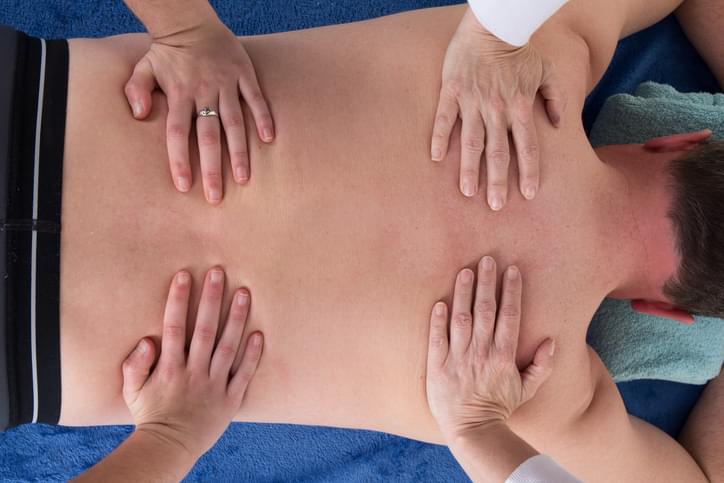
Four Hand Massage and Effective Relaxation
If you’ve ever had a massage where your brain just wouldn’t shut off—where you kept thinking, “Wait, are they still on my shoulder?”—Four Hand Massage has a way of silencing that internal chatter almost immediately.
Why? Because your brain can’t quite track what’s happening.
With two therapists working in step, there is simply too much happening at once to keep track of. Most people try for the first few minutes, give up, and stop trying. You don’t drift into it so much as fall into it—like being lowered into warm water.
In that sense it is less about working one stiff shoulder and more about covering the whole of you at once. Sessions are intended for relaxation and comfort only, and are not a treatment for any medical condition—but as an hour, it is a distinctly unusual one.
Learn more: Massage at Home
Four Hands, One Rhythm
Here’s the part that surprises people: it doesn’t feel more intense at all. It feels more even.
When two therapists work together, they mirror each other: the same stroke down both arms at once, both legs at once, both sides of the back at the same pace. What you get is a steady repeating pattern rather than the usual one-side-then-the-other. It is symmetrical in a way a single pair of hands can never quite be.
It is not mysterious. It is just two people keeping time.
Plenty of people fall asleep partway through, which is fine and fairly common. Others stay awake the whole time and describe it afterwards as the quietest hour they have had in months. Both are normal, and neither is the goal—there isn’t one.
Nowhere Gets Skipped
The most practical difference is simple arithmetic: an hour of four hands covers roughly twice the ground.
In a normal session, a therapist has to choose. Spend twenty minutes on the shoulders and the calves get five. With two of them working different areas at the same time, the usual trade-off mostly disappears—and the parts that normally get a quick pass at the end get proper time instead.
It is also warmer than a standard session, simply because more of you is being worked on at any given moment. People often mention that afterwards—not as a claim about anything, just as the thing they noticed most.
And honestly? An hour where nothing at all gets rushed is something most of us could use more often.
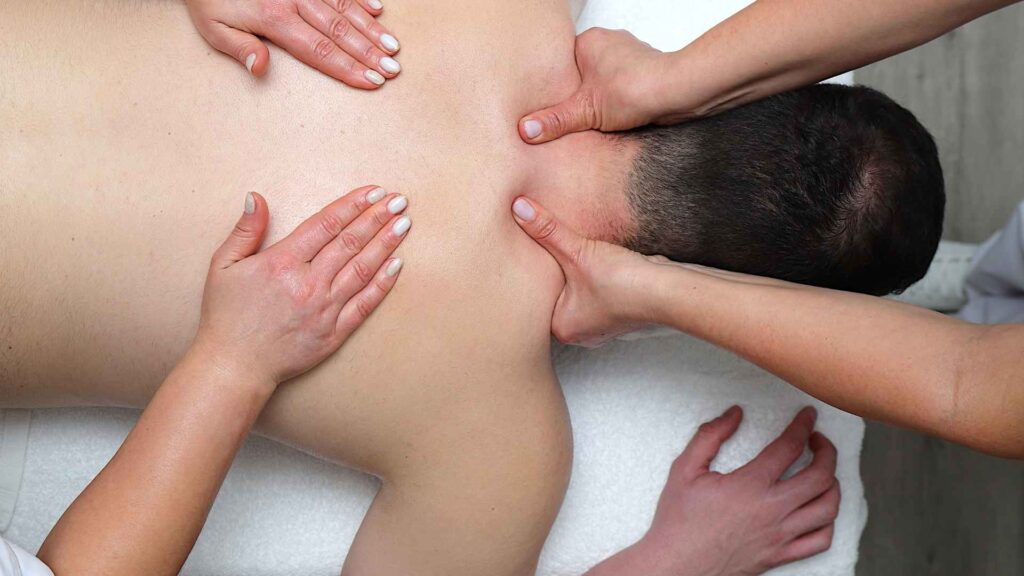
What Actually Differs From a Normal Session
Five practical differences, and none of them are claims about your health:
1. You Stop Keeping Track
There is too much happening at once to follow, so after a few minutes most people stop trying. That is the single most commented-on thing about it.
2. Greater Muscle Coverage
Two therapists can cover more ground—literally. While one works your shoulders, the other can be addressing your calves or lower back. No area is neglected.
3. The Strokes Are Symmetrical
Both arms, both legs, both sides of the back at the same time and the same pace. A single therapist works one side and then the other; this doesn’t.
4. It Is Warmer
More of you is in contact with somebody’s hands at any given moment, and more oil is being used. The room feels warmer than it does in a standard session, and it stays that way.
5. Customization and Control
Most Four Hand Massage sessions are personalized. Therapists adjust rhythm, pressure, and technique based on your comfort level. It’s your session, your way.
That said, not every massage is without its minor quirks. Some people find it hard to relax at first, especially if they’re not used to having more than one person working on them. And if the two therapists aren’t in sync? It can feel a little… off. That’s why experience matters.
Learn more: Lower Back Pain: What a Massage Is, and What It Isn’t
The Odd Part: Letting Yourself Be Looked After
This is the part people don’t expect. Two therapists, entirely focused on you, for an hour.
But hear me out.
You’re not doing anything productive. You’re not solving problems. You’re just… lying there. For some people that takes ten minutes to settle into, and it is worth saying so in advance rather than pretending everyone finds it easy.
Once it does settle, though, Four Hand Massage is about as unhurried as an hour gets. Nobody is waiting on you. Nothing is being asked. You get off the table more slowly than you got on it.
Sometimes the useful thing isn’t doing more. It’s having nothing to do for a little while.
Check this out: When Should I Get a Massage?
Final Thoughts: Is It Really Worth It?
Let’s be honest. Four Hand Massage isn’t something most people book every week. It takes two therapists’ time instead of one, and it is priced accordingly—ask when you book.
But for the occasions when you want the hour to be a bit of an event—a birthday, the end of a long stretch, or simply because you have never tried it—Four Hand Massage is a good one to pick.
If you have a diagnosed medical condition, or you are recovering from surgery or illness, please talk to your doctor before booking a session. Otherwise it is simply an hour, booked for no reason other than wanting it.
At Massage Heaven, the two therapists who work a four-hand session have worked together before. That coordination—the invisible choreography—is what makes or breaks it. When they are in step, you stop noticing there are two of them at all.
Is it indulgent? Certainly.
Is it unusual? Yes—most people have never had one.
Will you like it? That depends entirely on whether you enjoy being fussed over.